How it was designed
Designed with buildcad's AI agent, checked by the buildcad team. This is the request it started from and an edited account of what it did (more on how text to CAD works).
The request
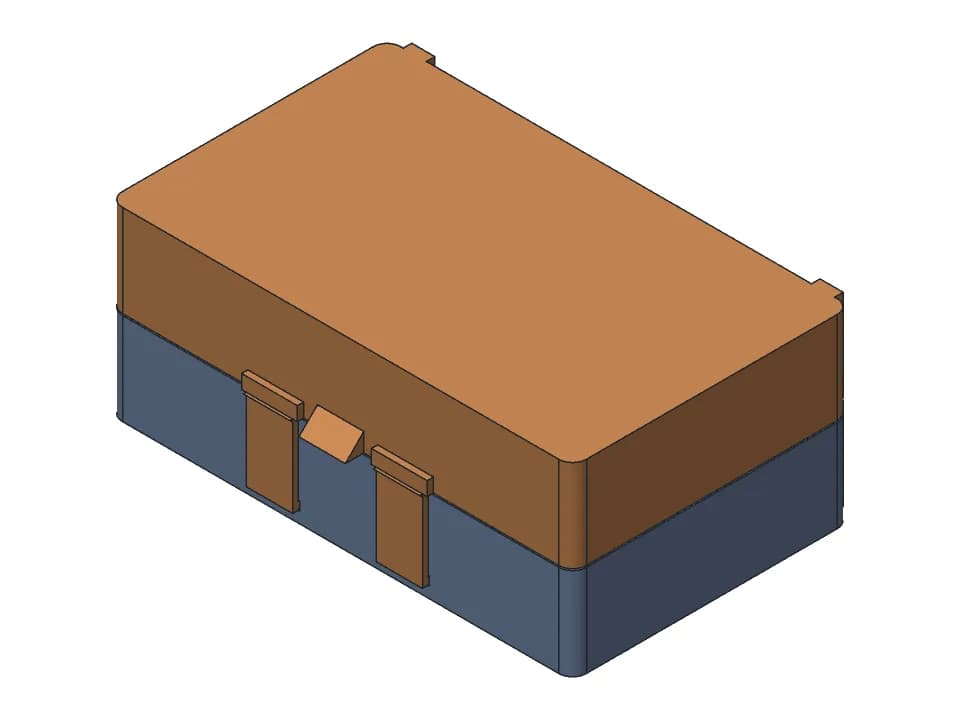
A box with a sliding lid that runs in grooves, about 120 x 80 x 40 mm, with a finger notch on the lid and a stop so the lid doesn't slide out the closed end.
- 1
It planned the size, the fit and the stop
The agent wrote checks for the 120 x 80 x 40 mm outside size, a 4 mm lid with 0.3 mm of play per side in the grooves, and one solid each for the box and the lid. It made the stop with blind grooves: they end at the closed end wall, so the lid cannot leave that way.
- 2
First build: tight above and below
The first model met every check, and the lid, put back in the grooves for a test, parked 0.3 mm short of the end wall. But the gap above and below the lid was only 0.15 mm, which the agent judged tight for printing.
- 3
Taller grooves
The agent made each groove 4.6 mm tall, the lid plus 0.3 mm above and below. The test fit then measured 0.3 mm everywhere with no overlap, and the slider sweep rebuilt all 20 extremes as one valid body per part.
- 4
The thumb dish, and what it left open
It used a round thumb dish near the open end instead of a notch through the lid edge, so the thumb has an edge to push against. On the model the dish is about 14 mm across and 2.2 mm deep. It did not print the box, and its reply suggests a short test print to confirm the sliding fit.
- 5
Our change
We made the model an assembly: the lid sits closed in its grooves and slides out along them in the viewer. The sweep measures 0.3 mm of play along the whole travel, finds the closed end wall as the stop at 0 mm, and the lid out of the grooves at the far end. The print plate lays both parts flat for the downloads; their shapes are unchanged.
One run of the agent: 1 min 35 s, about $0.21 of model time at list price (claude-sonnet-5-5). We changed the code afterwards, as described in the last step.