
Gridfinity generator: bins and baseplates
Make Gridfinity bins and baseplates to the spec, in your browser. For a bin, set the size in grid units and the height in 7 mm units, then add dividers, a finger scoop, a label tab, magnet or screw holes. For a baseplate, type the inside size of your drawer and pick your printer: you get the largest grid that fits, a border for the rest, and pieces that fit your bed with clips to join them.
- Free, no account to download
- STL, 3MF and STEP
- Checked to seat and stack
Custom insert for your tools: describe or photograph them
Tell the AI designer what goes in the bin (or attach a photo with a ruler next to the tools) and it builds a Gridfinity bin with a pocket and a finger slot for each one, as CAD you can still adjust.
Size in 42 mm grid units, height in 7 mm units.
Every model is built on our CAD engine from the published dimensions (42 mm grid, 7 mm height units, 0.25 mm clearance per side, the 0.8 / 1.8 / 2.15 mm foot profile and the stacking lip) and checked: a bin seats in the baseplate and stacks on another bin without overlapping. Download STL or 3MF for your slicer, or STEP to edit it in Fusion, Onshape or FreeCAD. Free, and no account is needed to download.
Start from an example
Finished designs from the Library to start from: open one, set its sliders, download it or change it with AI.
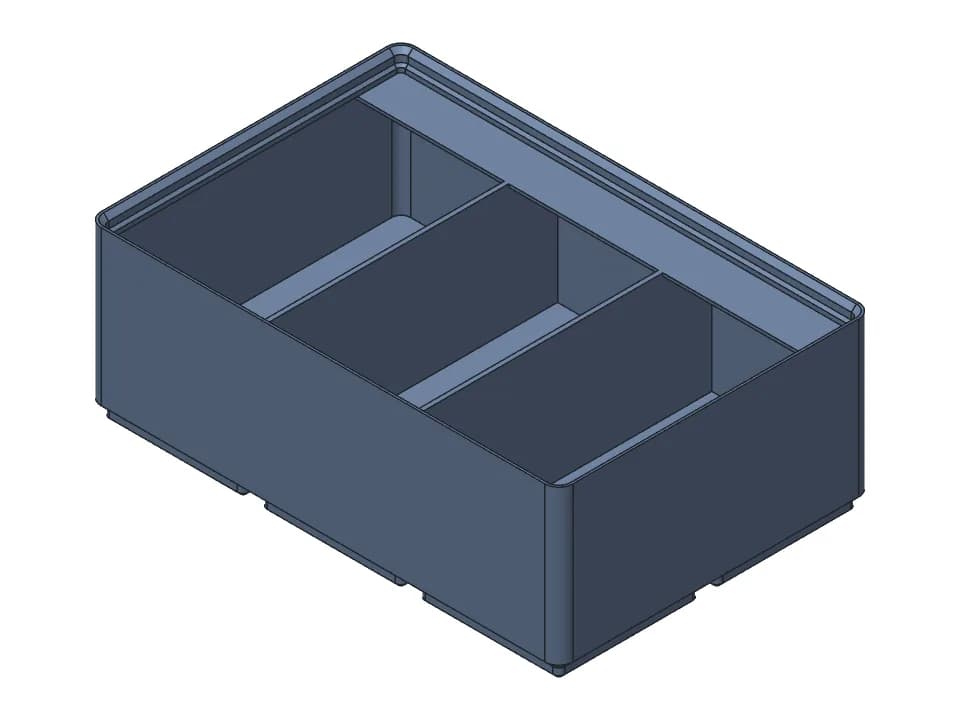
Gridfinity bin with label lip
3 x 2 Gridfinity bin with 3 compartments, a 13 mm label shelf and a finger scoop, sized in the browser.
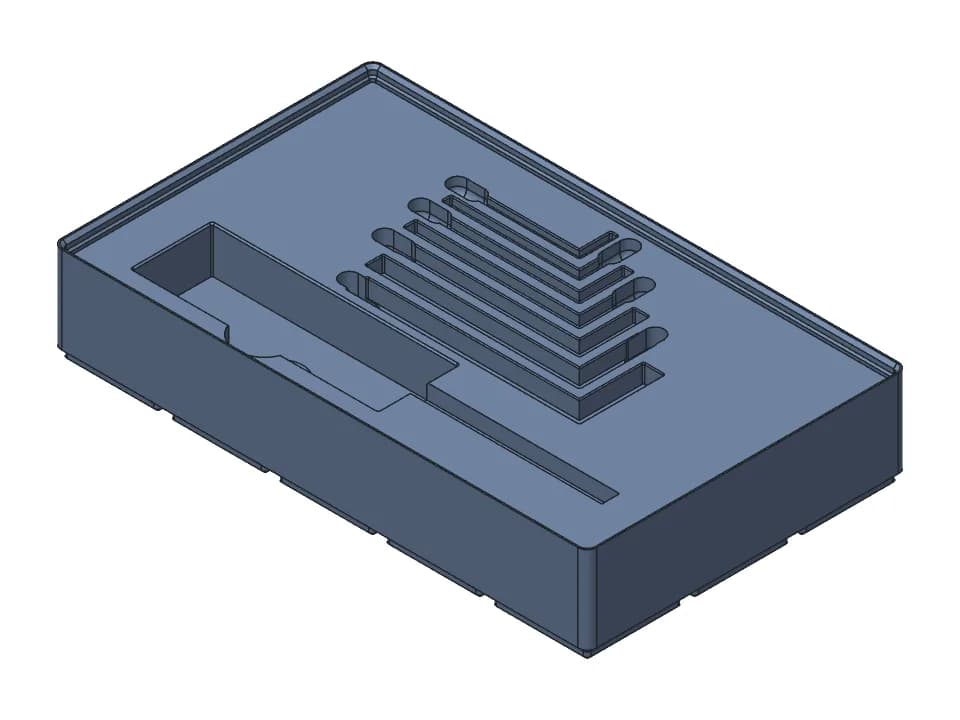
Gridfinity tool insert: screwdriver and hex keys
5 x 3 Gridfinity insert with a pocket and finger slot for a screwdriver and 7 metric hex keys.
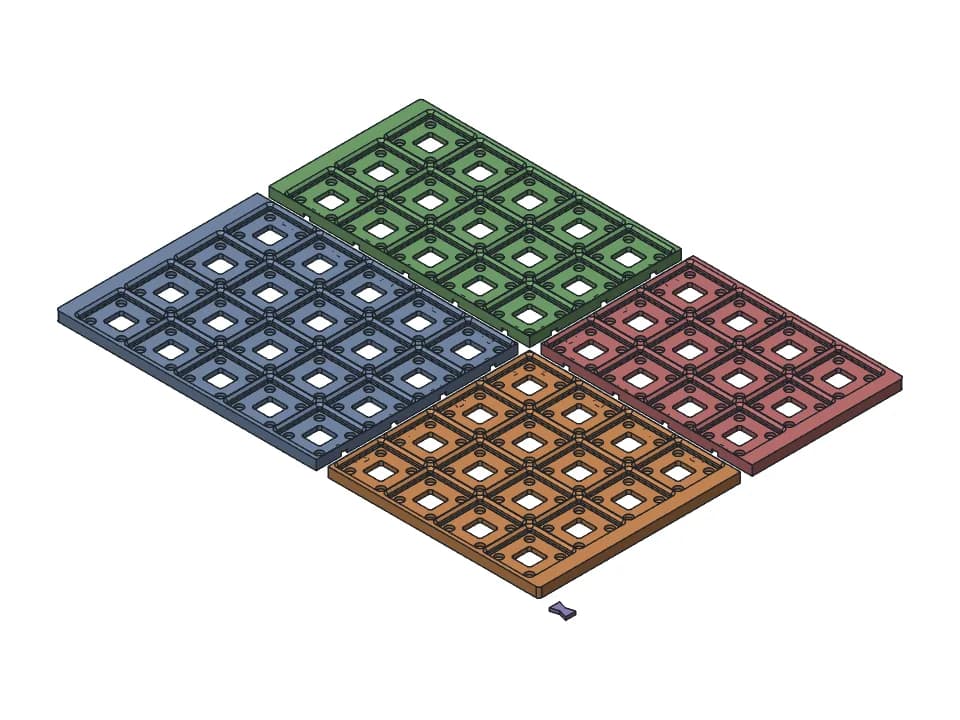
Gridfinity baseplate with magnets
Magnet baseplate for a 400 x 300 mm drawer: a 9 x 7 grid in 4 pieces with clips, any drawer size.
What is Gridfinity?
Gridfinity is a modular storage system designed by Zack Freedman and released as open source (MIT licence): bins on a 42 mm grid that drop into a baseplate glued, screwed or just laid in a drawer, and stack on each other when you need them out of the way. Because the dimensions are open, there are thousands of compatible bins, holders and inserts to mix with the ones you make here. See Zack Freedman's video that introduced it, the community wiki and spec at gridfinity.xyz, and gridfinity-rebuilt-openscad, the reference implementation our numbers were checked against.
Gridfinity dimensions
Every number the generator uses. A bin is always 0.5 mm smaller than the cells it covers, so it drops in without binding, and the feet center it in the baseplate on their 45 degree faces.
| Feature | Size | Notes |
|---|---|---|
| Grid unit | 42 x 42 mm | Every bin and baseplate cell |
| Height unit | 7 mm | A bin of n units is 7 x n mm to the top of its wall |
| Bin size | 42 x n - 0.5 mm | 0.25 mm clearance on each side: 41.5, 83.5, 125.5 mm |
| Bin corner radius | 3.75 mm | Baseplate openings and outer corners: 4 mm |
| Foot profile, bottom up | 0.8 / 1.8 / 2.15 mm | 45 degrees, straight, 45 degrees: 4.75 mm tall |
| Foot bottom | 35.6 x 35.6 mm | Radius 0.8 mm, one foot per cell |
| Inside floor | 7 mm | The base: the feet plus a 2.25 mm bridge joining them |
| Baseplate profile, bottom up | 0.35 / 0.7 / 1.8 / 2.15 mm | Straight, 45 degrees, straight, 45 degrees: 5 mm nominal |
| Stacking lip, bottom up | 0.7 / 1.8 / 1.9 mm | From the top of the wall; 4.4 mm nominal, about 3.8 mm once the top edge is rounded or flattened |
| Magnet holes | 6.5 x 2.4 mm | For 6 x 2 mm disc magnets, 4 per cell |
| Screw holes | 3 mm, 6 mm deep | M3, at the same 4 spots |
| Hole spacing | 26 mm | 13 mm from the cell centre, 8 mm in from the 42 mm cell edge |
| Weighted baseplate | 6.4 mm floor | A 21.4 mm square pocket, 4 mm deep, under each cell |
Bin sizes
| Grid units | Outside size | Height, units + 1 (wall) | With stacking lip |
|---|---|---|---|
| 1 | 41.5 mm | 14 mm | 17.8 mm |
| 2 | 83.5 mm | 21 mm | 24.8 mm |
| 3 | 125.5 mm | 28 mm | 31.8 mm |
| 4 | 167.5 mm | 35 mm | 38.8 mm |
| 5 | 209.5 mm | 42 mm | 45.8 mm |
| 6 | 251.5 mm | 49 mm | 52.8 mm |
Our two small departures from the nominal numbers, both on purpose: the stacking lip's sharp top is cut to a 0.6 mm flat (the reference implementation rounds it with a 0.6 mm fillet, which lowers it about as much), and the baseplate stops at 4.75 mm instead of 5 mm, so the sharp ridge between two cells cannot press into the bridge under a seated bin. Both still seat and stack with every bin that follows the spec.
How to size a Gridfinity baseplate for a drawer
cells = floor((inside width - 0.5) / 42)border on each side = ((inside width - 0.5) - 42 x cells) / 2
Measure the drawer's inside at the bottom, where the plate will lie, and in both directions. Example: a 300 x 250 mm drawer gives 7 x 5 cells (294 x 210 mm); the 5.5 mm left over in width becomes a 2.75 mm border on each side and the 39.5 mm left over in depth a 19.75 mm border at the front and back. On the Baseplate tab, pick your printer: a plate bigger than the bed is split between cells into pieces that fit with 5 mm to spare on each side, and each seam gets bowtie pockets underneath for the clips.
- Magnets need a 3.4 mm floor (2.4 mm pockets and 1 mm under them); screw holes a 2.4 mm floor; the open frame has no floor and uses the least plastic.
- A weighted baseplate (6.4 mm floor) takes a steel square, washers or coins in each cell: useful for a plate on a desk rather than in a drawer.
- Drawers with rounded inside corners: the plate's outer corners are rounded to 4 mm; for bigger radii, take 2 or 3 mm off the size you type.
Printing tips
- No supports: the feet, the lip, the label tab and the scoop are 45 degree slopes or gentler. Print bins feet down and baseplates flat.
- PLA is fine for most bins; PETG for bins that live in a hot car or a garage. 0.2 mm layers, 2 to 3 walls.
- Wall thickness: 1.2 mm (three 0.4 mm lines) is light and quick; 1.6 to 2 mm for heavy tools.
- Elephant foot makes the bottom of the feet wider and the bins tight in the plate: turn on elephant foot compensation (about 0.15 mm) in your slicer.
- Magnets go in after printing: press them in or use a dot of superglue, with the same pole up in every baseplate pocket and down in every bin.
Custom inserts for your tools
Sliders make standard bins; a bin shaped around your own pliers, bits or calipers needs the outline of each tool. The AI designer does that part: describe the tools with their length, width and thickness (or attach a photo with a ruler next to them), and it builds a Gridfinity insert with a pocket sized 0.5 mm over each tool and a finger slot to lift it out, using the same Gridfinity geometry as this page, as a design you can adjust and download like any other.
FAQ
Questions about the Gridfinity generator
What is Gridfinity?
Gridfinity is a modular storage system designed by Zack Freedman and released as open source under the MIT licence: bins on a 42 mm grid that drop into a baseplate in a drawer or on a desk, and stack on each other. Anyone can make parts that follow the spec, which is why there are thousands of compatible designs to mix with the ones you make here.
What are the Gridfinity dimensions?
The grid is 42 x 42 mm and heights go in 7 mm units. A bin is 0.5 mm smaller than its cells (41.5 mm for one cell, 83.5 mm for two), its feet have a 0.8 / 1.8 / 2.15 mm profile 4.75 mm tall, and the stacking lip adds about 3.8 mm on top. Magnet holes are 6.5 mm wide and 2.4 mm deep, 26 mm apart. The full table is on this page.
How tall is a Gridfinity bin?
7 mm per height unit from the bottom of the feet to the top of the wall, plus the stacking lip: a 6 unit bin is 42 mm to the top of the wall and 45.8 mm overall. The inside floor is 7 mm up, so a 3 unit bin holds 14 mm below the lip.
How do I size a Gridfinity baseplate for my drawer?
Measure the inside of the drawer at the bottom, take off half a millimetre so the plate drops in, and divide by 42: the whole number is how many cells fit and the rest is a border. A 300 x 250 mm drawer takes 7 x 5 cells (294 x 210 mm) with a 2.75 mm border left and right and 19.75 mm front and back. The Baseplate tab does this for you and splits the plate for your bed.
What magnets does Gridfinity use?
6 mm x 2 mm disc magnets, four per cell, in holes 6.5 mm wide and 2.4 mm deep. Glue them or press them in, and keep the same pole facing up in the baseplate and down in the bins so they attract.
Do I need magnets?
No. Bins locate in the baseplate by their shape alone. Magnets hold them down when a drawer slams or when you carry the plate around; a weighted baseplate keeps a loose plate from sliding on a desk.
Can I print a baseplate bigger than my print bed?
Yes. The generator splits it into pieces that fit your bed, with 5 mm free on each side, and cuts bowtie pockets under the seams. Print the clip as many times as it says and press the clips in to join the pieces.
How should I print Gridfinity bins?
PLA or PETG at 0.2 mm layers with 2 or 3 walls, feet down, no supports: the feet, the stacking lip and the label tab are 45 degree slopes. Thin walls (1.2 mm, three lines on a 0.4 mm nozzle) save time and plastic; go to 1.6 to 2 mm for heavy tools.
Can I make a custom insert for my tools?
Yes, with the AI designer: describe the tools with their length, width and thickness, or attach a photo with a ruler next to them, and it builds a Gridfinity bin with a pocket for each tool and finger slots to lift them out, as a CAD model you can still adjust with sliders.
Is the Gridfinity generator free?
Yes. The sliders, the preview and the STL, 3MF and STEP downloads are free with no account. Saving to your designs needs a free account; the AI designer for custom inserts uses credits, and new accounts start with free ones.
More free tools
Designing the rest of the part yourself? The guide to CAD for 3D printing compares the software and gives the FDM rules for walls, holes, overhangs and tolerances.
Gear generator
Spur gear pairs that mesh and turn, with the ratio, FDM backlash and a collision check.
Planetary gear calculator
Ratios for every fixed member, valid tooth counts from a target ratio, and a 3D set to print.
3D print hinge generator
Print-in-place hinges and hinged boxes, with the gap checked through the swing.
Box generator
Boxes sized by their inside, with a lift-off, sliding or hinged lid, dividers and labels.
Snap fits for 3D printing
Cantilever snap fits sized for FDM: strain per filament and print direction, STL to test.
Thread generator
Printable bolts and nuts, jar necks with screw caps and threaded inserts, with FDM clearance.
3D print tolerances
A clearance chart for FDM fits, and one small print that measures your own printer.
Need something these sliders can't make?
Describe the part in plain words: a gearbox for your motor, a box with this hinge, a case that snaps shut. The AI designer builds it as real CAD, checks the fit and the motion, and gives you sliders and print-ready files.
Start designing for free