
Snap-fit joints for 3D printing
A cantilever snap fit works when the arm bends far enough to clear the hook without going past what the printed plastic can take. Most snap-fit calculators are made for injection molding; this one uses FDM limits for PLA, PETG and ABS, and halves them when the arm stands along Z, where layer lines crack first.
- Free, no account to download
- STL, 3MF and STEP
- Motion checked for collisions
Cantilever snap-fit calculator for FDM
Strain at the root of the arm
0.63%
Under the 2% limit for PLA printed flat (31% of it).
Shortest arm for this hook: 6.7 mm. Highest hook on this arm: 1.28 mm.
strain = 1.5 x t x y / L²
Generate the snap-fit joint
Parameters
Loading the sliders...
Sliders and downloads are free. The AI designer uses credits; new accounts start with free ones.
Pick the filament and set the arm length, thickness and width, the hook depth (0 picks one at 60% of the limit), the lead-in angle and the clearance. The generator builds a snap tester, a plug with two arms and a socket with a window for each hook, gives the strain against the limit for the way the arm lies on the print plate, and pushes the plug home on our CAD engine to check the path is clear. Download STL, 3MF or STEP to test it on your printer.
Start from an example
Finished designs from the Library to start from: open one, set its sliders, download it or change it with AI.
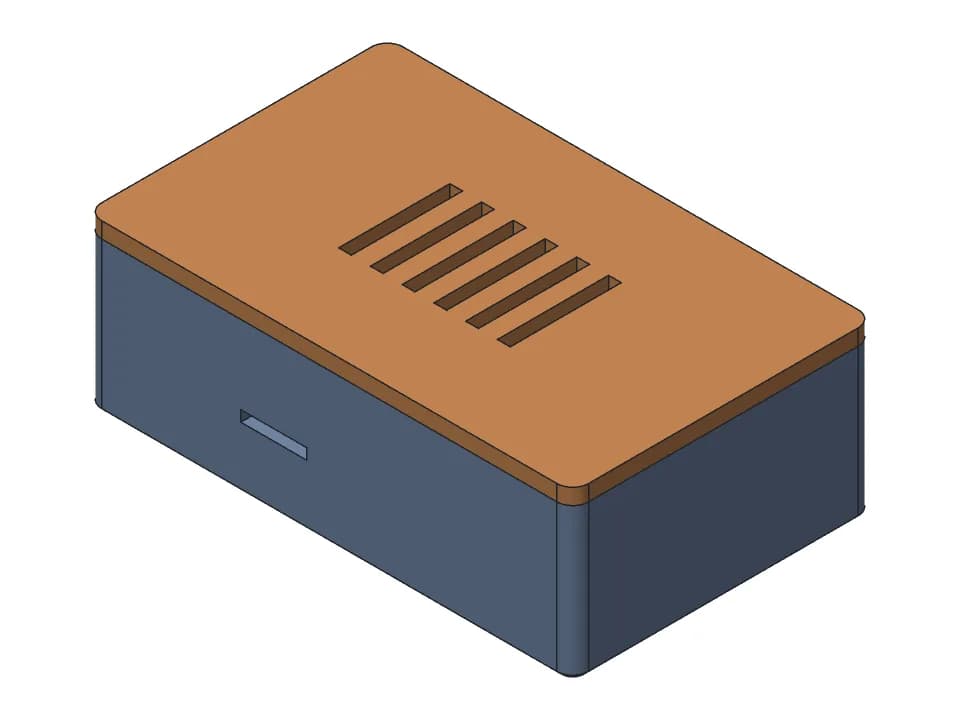
ESP32 enclosure
Base and vented snap-on lid for the ESP32-DevKitC V4: board on two ribs, micro-USB opening, no screws.
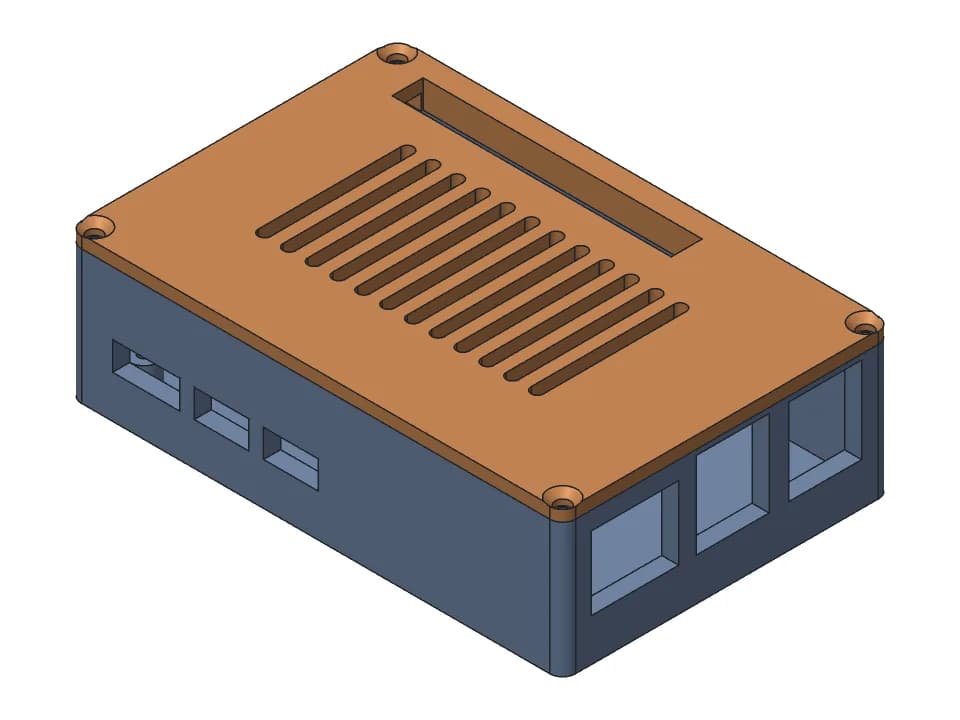
Raspberry Pi 5 case
Two-part Pi 5 case: base with screw bosses and port openings, vented lid screwed on with M2.5.
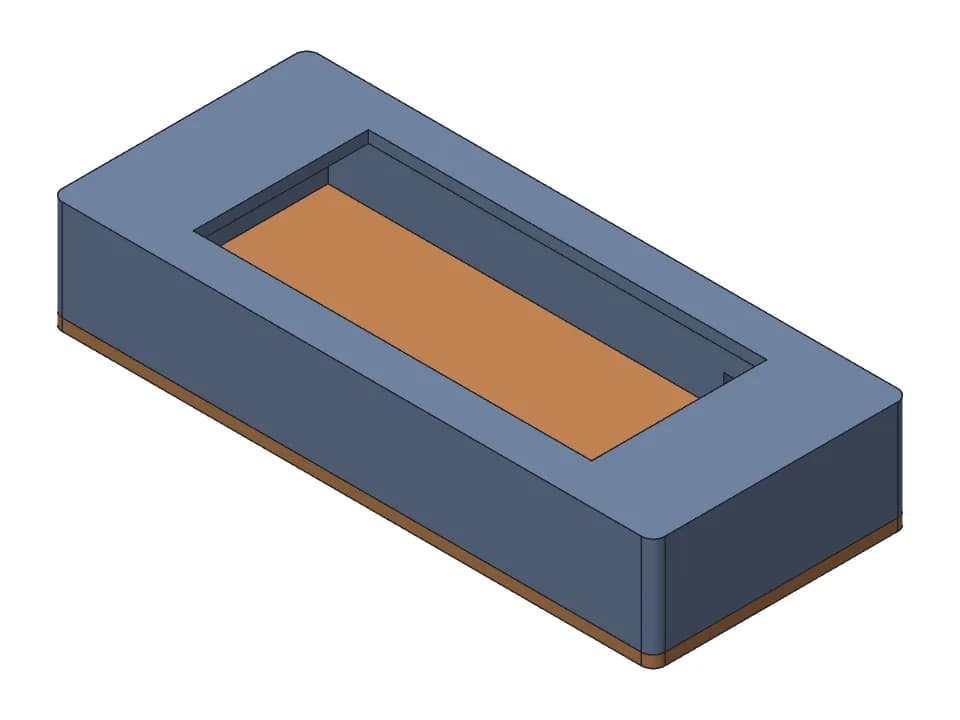
2.9 inch e-paper enclosure
Shell with a screen window for a 2.9 inch e-paper module on its driver board, and a lid with 2 M3 screws.
The four types of snap-fit joint
| Type | How it holds | For 3D printing |
|---|---|---|
| Cantilever | An arm with a hook bends as the parts go together and springs back into a window or over a ledge | The best choice: easy to size, prints flat, this generator makes it |
| U-shaped cantilever | A longer arm folded back on itself, so it fits a short space with less strain | Good in PLA when a straight arm would be over the limit; needs room behind it |
| Annular | A ring or lip that snaps over a groove all the way round (pen caps, bottle lids) | Hard in FDM: the whole ring must stretch; use thin walls, PETG or TPU |
| Torsional | A hook on a bar that twists; you press the other end to release | For latches you open often; print the bar flat |
How to calculate a cantilever snap fit
A cantilever snap fit is an arm with a hook at its end. Pushing the lid on bends the arm by the hook height; when the hook reaches its window, the arm springs back and holds. The design works if the strain at the root of the arm stays under what the filament can take.
strain = 1.5 x t x y / L²t = arm thickness, y = hook height, L = arm length
Example: an arm 12 mm long and 1.5 mm thick with a 0.38 mm hook: 1.5 x 1.5 x 0.38 / 144 = 0.59%. That is well under the 2% limit for PLA printed flat, and just over half the 1% limit if the same arm stood along Z.
| Material | Strain limit, arm printed flat | Arm along Z (layers across the bend) | Notes |
|---|---|---|---|
| PLA | 2% | 1% | Stiff and brittle: keep repeated snaps well under the limit |
| PETG | 3% | 1.5% | The usual choice for enclosures that open often |
| ABS / ASA | 3% | 1.5% | Similar to PETG, better heat resistance |
| TPU | no limit checked | no limit checked | Flexible: the hook holds by friction more than by strain |
Design rules that keep arms from cracking
- Make the arm longer before you make it thinner: strain falls with the square of the length.
- Round the root with a fillet of at least half the arm thickness (never under about 0.4 mm).
- Keep the arm at least 5 mm wide, and print it lying in the XY plane.
- Give the hook a 30 degree lead-in so it slides on, and a square back face so it holds.
- Leave about 0.3 mm of clearance around the latch so the hook drops in freely.
| Feature | Start with | Range | Notes |
|---|---|---|---|
| Clearance around a snap latch | 0.3 mm | 0.2 to 0.5 | So the hook drops into its window freely |
| Sliding fit (drawer, lid, dovetail) | 0.25 mm per side | 0.20 to 0.35; large parts 0.4+ | Friction rises sharply below 0.2 mm |
| First layer (elephant foot) | 0.5 mm x 45 deg chamfer | 0.3 to 1.0 mm | On the bottom edges of both mating parts; never start a moving gap on layer 1 |
| Living hinge | PETG or PP, 0.6 mm (3 layers) | 0.4 to 1.0; TPU 0.8 to 2.0 | Print flat; PLA lasts about 160 folds, PETG about 860 |
What the insertion check does
Besides the strain, the plug is slid into the socket on our CAD engine with the arms bent out of the way, and the parts are checked for collisions along the whole path. If a hook would hit the socket when closed (a missing window, for example), the check says so.
FAQ
Questions about the snap-fit generator
How do you calculate a cantilever snap fit?
For a straight arm of constant thickness, the strain at the root is strain = 1.5 x t x y / L squared, where t is the arm thickness, y the hook height (how far the arm bends) and L the arm length. A 12 mm arm, 1.5 mm thick, with a 0.38 mm hook gives 1.5 x 1.5 x 0.38 / 144 = 0.59%.
What strain can PLA and PETG take in a snap fit?
This calculator uses 2% for PLA and 3% for PETG and ABS/ASA when the arm prints flat, and half that when the arm stands along Z, because layer lines crack first. For a snap that is opened often, stay well under the limit. TPU is flexible enough that strain is not the limit.
Which way should I print a snap-fit arm?
Lying flat, so the arm bends across the layers in the XY plane. An arm printed standing up bends along the layer lines and breaks at about half the strain.
How do I make a snap fit stronger without breaking it?
Make the arm longer before making it thinner: strain falls with the square of the length. Add a root fillet of at least half the arm thickness, keep the hook height small, and leave about 0.3 mm of clearance around the latch.
What are the types of snap-fit joints?
Cantilever (an arm with a hook, the most common and the easiest to print), U-shaped cantilever (a longer arm folded back, for tight spaces or brittle materials), annular (a ring that snaps over a lip, as on pen caps) and torsional (a hook on a twisting bar, for latches you press to release). On FDM printers the cantilever is the safest choice.
Is the snap-fit calculator free?
Yes. The calculation, the 3D preview and the STL, 3MF and STEP downloads are free and need no account.
More free tools
Designing the rest of the part yourself? The guide to CAD for 3D printing compares the software and gives the FDM rules for walls, holes, overhangs and tolerances.
Gridfinity generator
Gridfinity bins and baseplates to the spec, baseplates sized to your drawer and split for your bed.
Gear generator
Spur gear pairs that mesh and turn, with the ratio, FDM backlash and a collision check.
Planetary gear calculator
Ratios for every fixed member, valid tooth counts from a target ratio, and a 3D set to print.
3D print hinge generator
Print-in-place hinges and hinged boxes, with the gap checked through the swing.
Box generator
Boxes sized by their inside, with a lift-off, sliding or hinged lid, dividers and labels.
Thread generator
Printable bolts and nuts, jar necks with screw caps and threaded inserts, with FDM clearance.
3D print tolerances
A clearance chart for FDM fits, and one small print that measures your own printer.
Need something these sliders can't make?
Describe the part in plain words: a gearbox for your motor, a box with this hinge, a case that snaps shut. The AI designer builds it as real CAD, checks the fit and the motion, and gives you sliders and print-ready files.
Start designing for free