How it was designed
Designed with buildcad's AI agent, checked by the buildcad team. This is the request it started from and an edited account of what it did (more on how text to CAD works).
The request
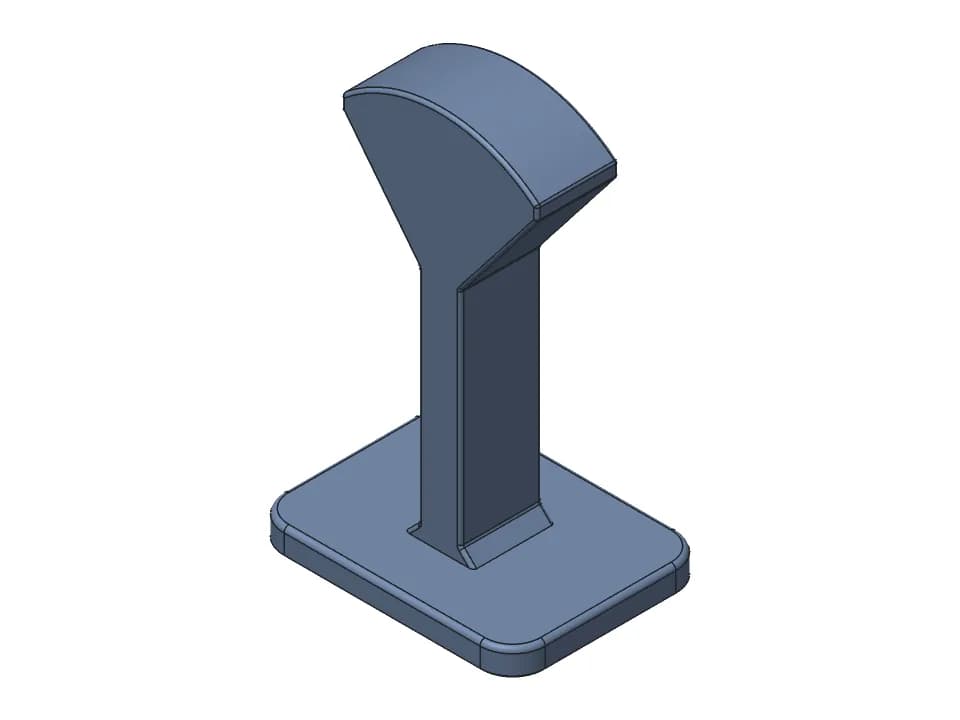
A desk phone stand for phones up to 10 mm thick with a case, holding the phone at about 65 degrees, charging while it stands: leave room under the phone for a straight USB-C plug and a slot to route the cable out the back.
- 1
It set the defaults from the prompt
The agent took a 10 mm phone and case with 1 mm of play, an 85 mm wide stand and a phone up to about 165 mm long for the tip-over check, each as a slider. It wrote six checks: the 65 degree angle, an 11 mm slot, 32 mm of open space under the phone, a clear cable path out the back, the width and a flat base.
- 2
A stand with an open middle
To leave room for a straight plug, the phone rests on two side pads with front lips, and the middle stays open. The first build was one valid body of 85 x 87.2 x 123.1 mm, with only 0.3% of its surface counted as overhang.
- 3
Probes that missed
Its first rays across the slot returned nothing: once the start point was off, then the direction had its axes swapped. With the direction fixed, the ray found a 4 mm lip, an 11 mm gap and the backrest behind it. The two largest faces of the backrest measured 65.0 degrees.
- 4
Plug and cable path
A ray from the middle of the phone's bottom edge, straight down along the phone, ran 40 mm before it met the groove floor, against the 32 mm asked for. A ray along the cable route found no material from the groove to the back edge. The slider sweep then rebuilt all 28 extremes as valid single bodies.
- 5
What it left to the maker
Its reply says it was not test-printed, asks the maker to measure the plug's moulding, notes that an off-centre port may need a wider slot, and suggests low infill and rubber feet.
One run of the agent: 4 min 16 s, about $0.57 of model time at list price (claude-sonnet-5-5). The model code behind this page is the code it wrote, unchanged.