BuildCAD AI

Under-desk J hook, customizable: clamps on an 18 to 30 mm desk, no screws

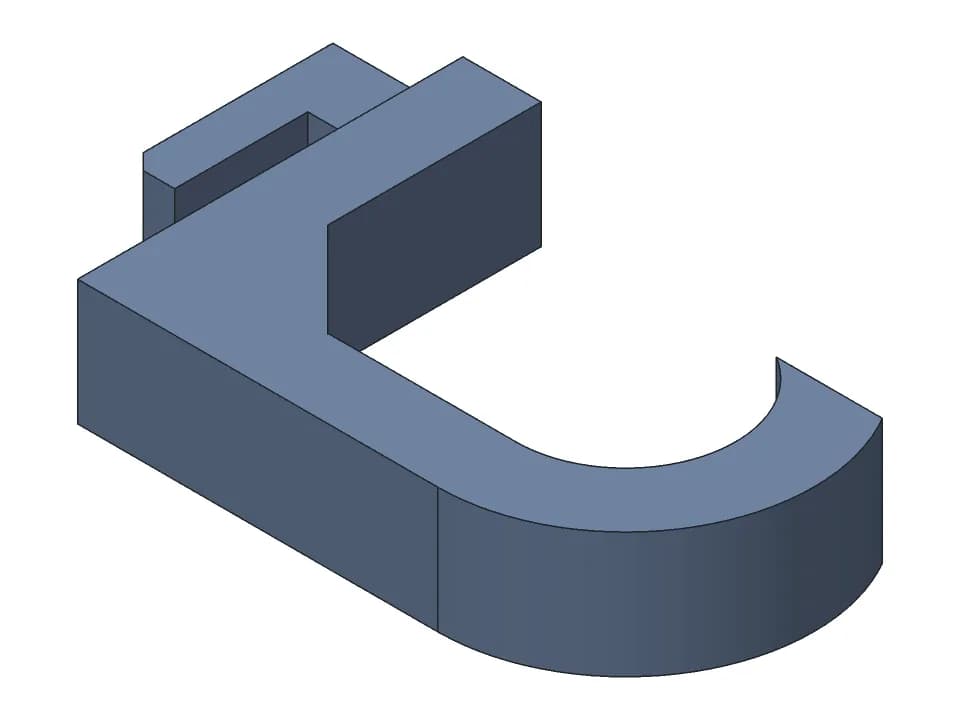
A one-piece hook that clamps on a desk edge with no screws, and hangs headphones or a bag below it. The desk slides into a C-shaped mouth: a rigid jaw goes under the desk and a spring arm with a round grip rib presses on top. A 28 mm wide J cup hangs 45 mm below and opens toward you. The defaults cover desks 18 to 30 mm thick, on a 120 x 107 x 25 mm part. Set the desk range, the squeeze, the arm and the hook.

Customize Change it with AIFree STL, 3MF and STEP, no accountMeasured on the model

Parameters

Thinnest deskmm
Thickest deskmm
Squeeze on thinnest deskmm
Width of clamp and hookmm
Spring arm lengthmm
Spring arm thickness (tip)mm
Lower jaw thicknessmm
Back / hook thicknessmm
Hook drop below the jawmm
Hook cup inner radiusmm
Hook tip risemm

Sliders and downloads are free. Changes by the AI designer use credits like any design; new accounts start with free ones.

It prints flat on its side with no supports, so the layers run along the spring arm. Use PETG. With no desk, the rib sits 15 mm above the jaw face, so the arm bends about 3 mm on an 18 mm desk and about 15 mm on a 30 mm desk. The ramped tips open to about 22 mm, so on a thicker desk you lift the arm by hand to start. Grip and strength were not tested: try one on your desk first.

Parameters

Every slider in the viewer above, with the range the model accepts. The model rebuilds valid at both ends of each range.

ParameterRangeDefaultWhat it changes
Thinnest desk10 to 30 mm18 mmThe thinnest desk you want to grip. With the squeeze below, it sets the relaxed gap at the grip rib.
Thickest desk20 to 40 mm30 mmThe thickest desk you want to grip. It sets the opening at the back of the mouth.
Squeeze on thinnest desk1 to 5 mm3 mmHow far the arm is bent open on the thinnest desk. Raise it for a firmer grip, lower it if the clamp is too stiff to push on.
Width of clamp and hook15 to 50 mm25 mmWidth of the clamp and hook, which is the print height. A wider clamp grips more of the desk and spreads a strap.
Spring arm length50 to 100 mm70 mmDistance from the back of the mouth to the grip rib. A longer arm bends more easily and reaches further onto the desk.
Spring arm thickness (tip)2.5 to 5 mm3.5 mmThickness of the spring arm at its tip (it is 1.5 times thicker at the root). Thicker grips harder but is harder to push on.
Lower jaw thickness3 to 8 mm5 mmThickness of the rigid lower jaw under the desk.
Back / hook thickness4 to 10 mm6 mmThickness of the back of the clamp and of the J hook.
Hook drop below the jaw20 to 100 mm45 mmHow far the hook cup hangs below the lower jaw.
Hook cup inner radius8 to 30 mm14 mmInside radius of the hook cup: 14 mm gives a 28 mm wide cup for a headphone band.
Hook tip rise6 to 40 mm16 mmHow high the front tip of the J rises, which keeps a strap from sliding off.

Proof: measured on the model

What the design must satisfy and what our CAD engine measured on the model at the default values. Only measured values are shown here; nothing on this page has been printed by us yet.

RequirementWantedMeasured
Opening at the back of the mouth, 2 mm from the spine31 mm, more than the 30 mm thickest desk31.063 mm
Relaxed gap at the grip rib, down to the small tooth under it14.3 mm (15 mm to the jaw face less a 0.7 mm tooth), less than the 18 mm thinnest desk14.3 mm
Opening between the ramped tips, 1 mm from the jaw endabout 22 mm21.763 mm
Inside width of the J cup28 mm (2 x 14 mm radius)28 mm
Clamp and hook width25 mm (the slider)25 mm
  • valid solid, one body, 120 x 106.8 x 25 mm, fits a 256 x 256 x 256 mm printer; overhangs: 0.0% of surface would need support.

Print notes

Orientation
Flat on its side, as modelled: the clamp's profile lies on the bed, so the layers run along the spring arm.
Supports
None
Material
PETG: the spring arm bends every time you fit it, and PETG tolerates that better than PLA
Layer height
0.2 mm
Settings
4 walls or more, so the spring arm prints nearly solid
Hardware
None
Time and filament
About 1 h 20 min and 29 g at the default size: a rough estimate from the model's volume and surface (PLA, 15% infill, about 1 mm of walls, 0.2 mm layers), not a slicer.
  • Print one and try it on your desk first. If it grips too weakly, raise Squeeze on thinnest desk or the arm thickness. If it is too stiff to push on, lower them or lengthen the arm.
  • On a desk thicker than about 21 mm, lift the arm tip by hand to start it onto the edge, then push until the edge reaches the back of the mouth.
  • The arm and the jaw reach about 80 mm onto the desk, above and below, so there must be no lip, cable tray or frame that close to the edge.
  • Meant for headphones or a small bag. The agent suggests about 1 to 2 kg at most, but strength was not tested.

How it was designed

Designed with buildcad's AI agent, checked by the buildcad team. This is the request it started from and an edited account of what it did (more on how text to CAD works).

The request

An under-desk J hook that clamps on a desk edge 18 to 30 mm thick to hang headphones or a bag, no screws.

  1. 1

    Checks before the model

    The agent wrote its checks first: a 25 mm wide part in one piece, plus two beam-formula estimates for the spring arm, bending strain under 2% on the thickest desk and at least 4 N of clamping force on the thinnest.

  2. 2

    First build: 50 mm wide

    The first model was one valid body, but 50 mm wide instead of 25, reaching 25 mm below the bed, with 1685 mm2 of overhang. Probes through the mouth already showed 31 mm at the back and 15 mm at the rib.

  3. 3

    It found the stray piece

    The agent built the pieces on their own to find the one that was off: a polygon drawn clockwise extruded downward, to Z -25. It made every extruded outline come back to Z 0 to 25, and the clamp rebuilt 25 mm wide, flat on the bed, with no overhang.

  4. 4

    Measured gaps and every extreme

    It added two measured checks, 31.06 mm at the back of the mouth and 15 mm from the jaw face to the rib, and the slider sweep rebuilt all 22 extremes as one valid body each. Its estimates gave about 1.6% strain on a 30 mm desk and about 8 N of clamping force on an 18 mm one.

  5. 5

    What it left to the maker

    Its reply says the strain and force are estimates from beam formulas and nothing was test-printed. It suggests a test print, light loads of about 1 to 2 kg, and setting both desk sliders close to your real desk for a firmer hold.

One run of the agent: 3 min 30 s, about $0.44 of model time at list price (claude-sonnet-5-5). The model code behind this page is the code it wrote, unchanged.
Change it with AI

Set the sliders, then press Change it with AI: a copy goes to your designs at those sizes and the designer opens with a suggested change you can edit. Its changes use credits like any design; new accounts start with free ones.