BuildCAD AI

Pegboard hook, customizable: locks behind 1/4 inch pegboard, any arm length

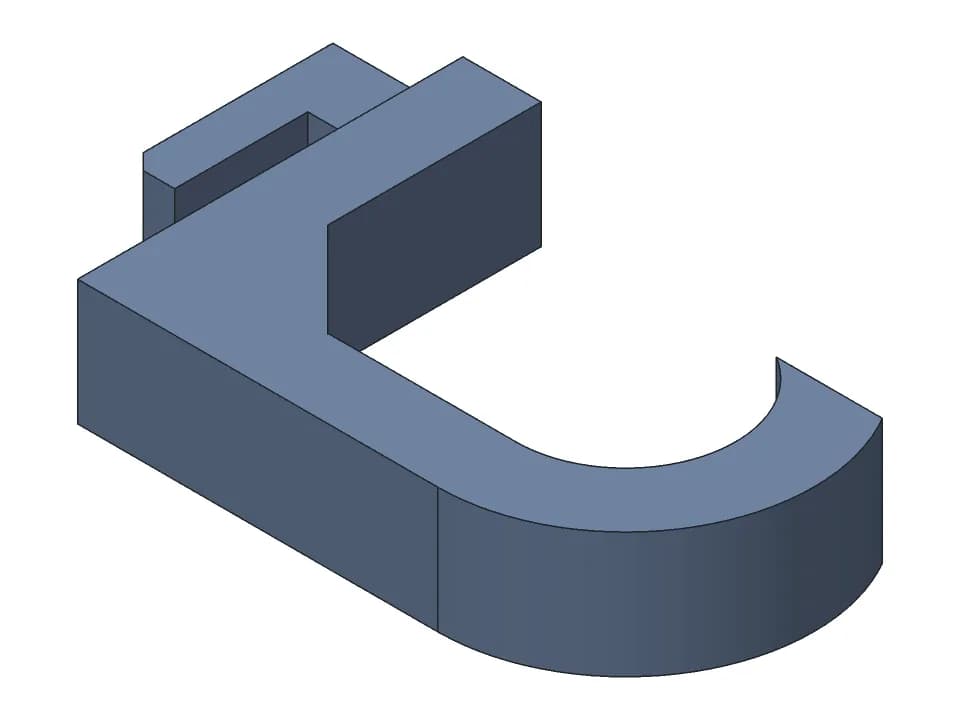
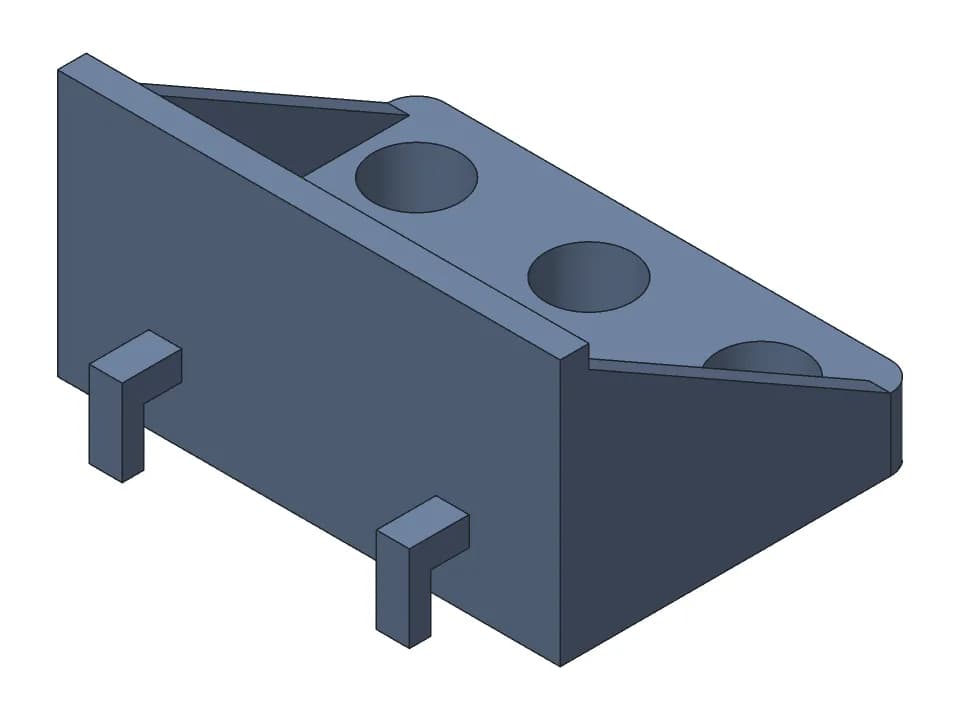
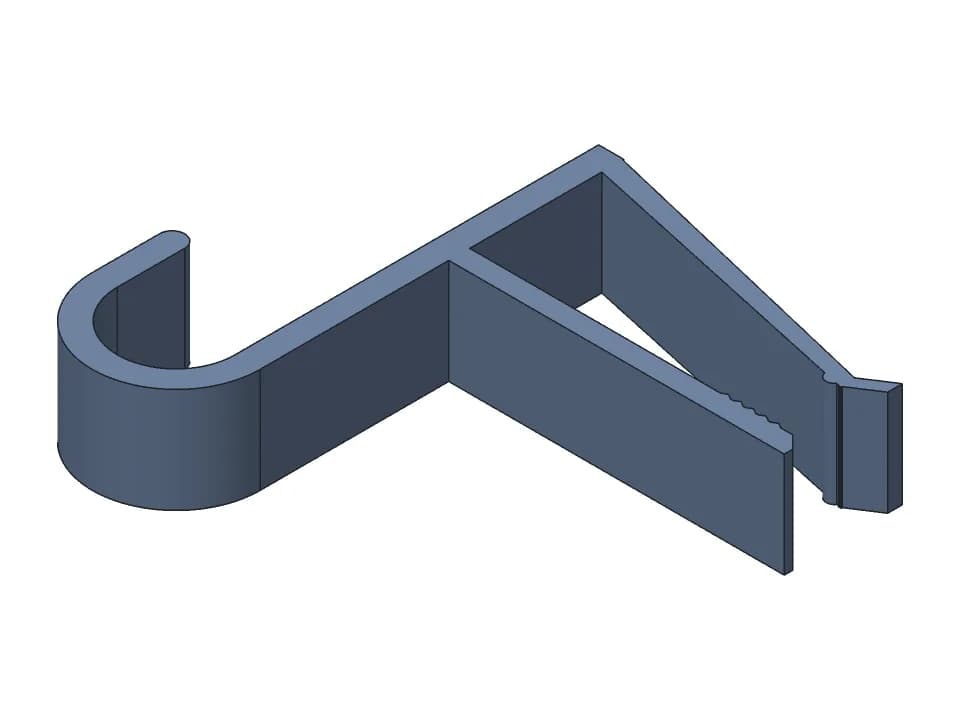
A one-piece hook for standard pegboard with 1/4 in (6.35 mm) holes on 1 in (25.4 mm) spacing. Like a metal hook, its upper peg turns down behind the board and a straight lower peg sits 1 in below, so a load on the arm cannot pull it out. The arm reaches 50 mm from the board face, with a 12 mm lip. Set the arm length (30 to 120 mm), lip, hook width, board thickness, hole size and peg clearance.

Customize Change it with AIFree STL, 3MF and STEP, no accountMeasured on the model

Parameters

Board hole diameter (1/4 in)mm
Hole spacing (1 in)mm
Board thickness (1/8 in)mm
Arm length from board facemm
Arm heightmm
Lip height above armmm
Lip thicknessmm
Hook widthmm
Back plate thicknessmm
Peg clearance in holemm
Peg thickness (up-down)mm
Hook leg thicknessmm

Sliders and downloads are free. Changes by the AI designer use credits like any design; new accounts start with free ones.

It prints lying on its side with no supports. To hang it, lift it slightly, push both pegs straight in, then let it drop: the down-turned leg then reaches 2.6 mm below the hole edge. That path was checked on the model against a 3.2 mm board with 6.35 mm holes, using exact sizes, so print one and try it on your board. The pegs are small (3.2 x 5.5 mm) and strength was not checked.

Parameters

Every slider in the viewer above, with the range the model accepts. The model rebuilds valid at both ends of each range.

ParameterRangeDefaultWhat it changes
Board hole diameter (1/4 in)5 to 9 mm6.35 mmDiameter of the holes in your board. The pegs are this minus the clearance.
Hole spacing (1 in)20 to 40 mm25.4 mmDistance between the two holes the pegs use, one above the other: 25.4 mm on 1 in pegboard.
Board thickness (1/8 in)2 to 7 mm3.2 mmThickness of your pegboard. It sets where the upper peg turns down and how far the lower peg reaches.
Arm length from board face30 to 120 mm50 mmHow far the arm reaches from the board face to the outside of the lip.
Arm height6 to 20 mm10 mmHeight of the arm in the direction of the load. Raise it for long arms or heavier tools.
Lip height above arm4 to 30 mm12 mmHow high the lip at the end rises above the top of the arm.
Lip thickness2.4 to 8 mm4 mmThickness of the end lip.
Hook width6.5 to 20 mm8 mmWidth of the hook, which is the print height. It never gets narrower than the pegs plus 1 mm.
Back plate thickness3 to 8 mm4 mmThickness of the back plate that sits against the board face.
Peg clearance in hole0.3 to 1 mm0.55 mmHow much narrower than the hole the pegs are. Raise it if the hook will not go in, lower it if it is loose.
Peg thickness (up-down)2.6 to 4.2 mm3.2 mmUp-down thickness of the pegs. Thicker pegs are stronger, but the model caps them so the hooked end still fits through the hole.
Hook leg thickness2.4 to 6 mm3 mmThickness of the down-turned leg behind the board.

Proof: measured on the model

What the design must satisfy and what our CAD engine measured on the model at the default values. Only measured values are shown here; nothing on this page has been printed by us yet.

RequirementWantedMeasured
Arm reach from the board face to the outside of the lip50 mm (the slider)50 mm
Distance between the two pegs25.4 mm (1 in)25.4 mm
Peg width across the 6.35 mm hole5.5 mm (5.8 mm less a 0.3 mm flat for the bed)5.5 mm
Height of the upper peg and its leg together, which must pass the 6.35 mm hole5.8 mm5.8 mm
How far the leg drops below the upper peg, behind the board2.6 mm2.6 mm
How far the upper peg reaches behind the board face6.8 mm (3.2 mm board, 0.6 mm air, 3 mm leg)6.8 mm
  • valid solid, one body, 56.8 x 37.4 x 8 mm, fits a 256 x 256 x 256 mm printer; overhangs: 0.0% of surface would need support.

Print notes

Orientation
On its side, as shown: the hook's profile lies flat on the bed, so the layers run along the arm and the pegs.
Supports
None
Material
PETG or another tough filament for heavy loads, since the pegs are small; PLA for light ones
Layer height
0.2 mm
Settings
4 walls, so the 3.2 mm pegs print nearly solid
Hardware
None
Time and filament
About 15 min and 4 g at the default size: a rough estimate from the model's volume and surface (PLA, 15% infill, about 1 mm of walls, 0.2 mm layers), not a slicer.
  • Print one hook and try it on your board first. The install path was checked with exact sizes, so printer tolerance matters: raise Peg clearance in hole if it will not go in, lower it if it is loose.
  • To hang it, lift it about 1 mm above the holes, push both pegs straight in, then let it drop about 2.6 mm. To take it off, lift it about 2.6 mm and pull it straight out.
  • For a 1/4 in thick board, set Board thickness to about 6.4 mm.
  • Strength was not tested. For long arms or heavy tools, raise the arm height and the hook width.

How it was designed

Designed with buildcad's AI agent, checked by the buildcad team. This is the request it started from and an edited account of what it did (more on how text to CAD works).

The request

A pegboard hook for standard 1/4 inch holes on 1 inch spacing, with a 50 mm long arm and a lip at the end. It must stay in the board under load like a metal pegboard hook: an upper peg that hooks down behind the board and a lower straight peg 1 inch below it.

  1. 1

    Checks before the model

    The agent wrote its checks first: a 50 mm reach to the outside of the lip, one body flat on the bed, and an upper peg that reaches 6.5 to 7.5 mm behind the board face before it turns down.

  2. 2

    First build: it could not go in

    The first hook had 4.6 mm thick pegs and a 12 mm leg behind the board, and every check passed. The agent then searched for a way to put it on a model of a 3.2 mm board with 6.35 mm holes, sliding and tilting it: no path existed.

  3. 3

    It searched for sizes that fit

    It tried thinner pegs, shorter legs and a wider search with more tilt, still with no path. A tall bent leg cannot pass a 1/4 in hole. Thin 3 mm pegs with a short catch of 2.6 to 3 mm went in straight, with no tilt at all.

  4. 4

    Thin pegs, short catch

    The agent rebuilt the hook with 3.2 x 5.5 mm pegs and a leg sized so the hooked end is 5.8 mm tall, less than the hole. The search found the path: lift about 1.1 mm, push both pegs straight in, drop about 2.6 mm onto the bottoms of the holes. Hanging, the leg sits 2.6 mm below the hole edge.

  5. 5

    Every slider extreme

    It added checks for the peg width (5.5 mm), the 25.4 mm spacing and the 5.8 mm hooked end, and the slider sweep rebuilt all 24 extremes as one valid body each.

  6. 6

    What it left to the maker

    Its reply says the hook was not printed or tried on a real board, and that the install check uses exact sizes. It asks for one test hook first, and tough filament for heavy loads because the pegs are small.

One run of the agent: 9 min 6 s, about $1.20 of model time at list price (claude-sonnet-5-5). The model code behind this page is the code it wrote, unchanged.